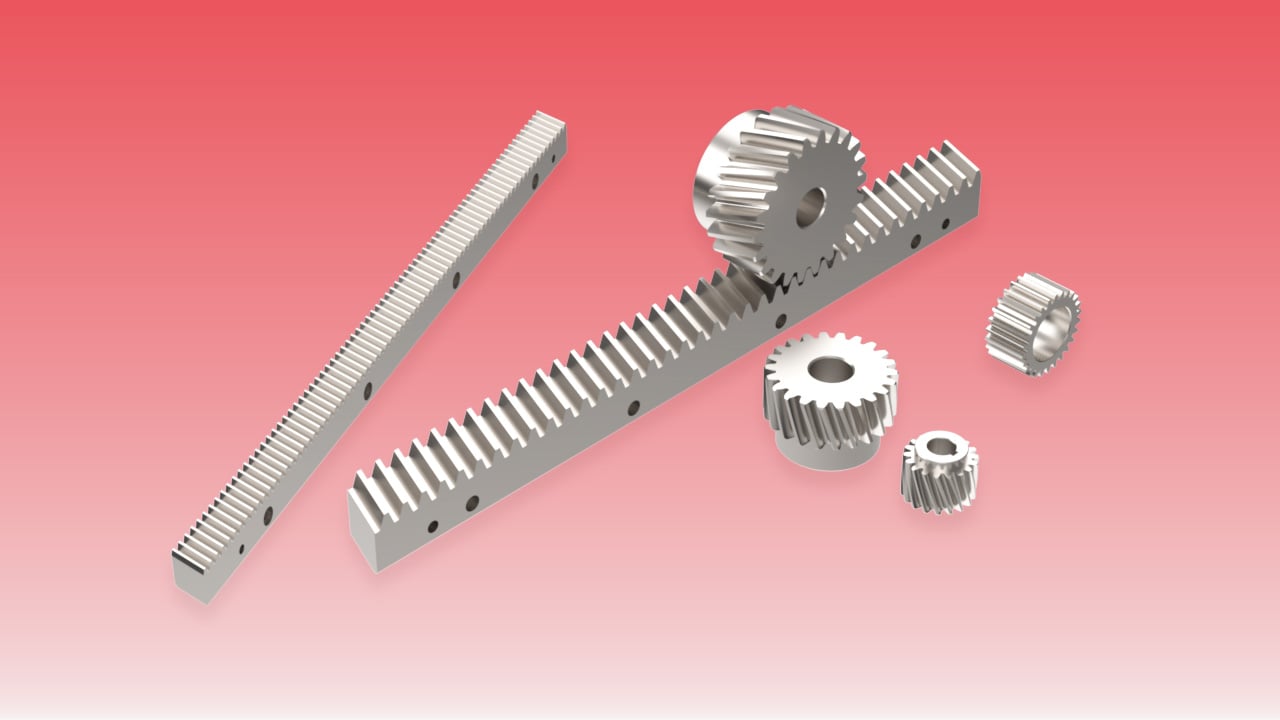
Racks and pinions are important components in modern mechanical engineering. They convert rotational motion into linear motion with high precision and strength – a solution used in everything from automation systems to heavy lifting applications. In this article, we will review design principles and common areas of use.
The strength lies in simplicity
In its simplest form, a rotating pinion drives a rack forward or backwards. The result is a powerful and highly precise linear motion that does not risk slipping, as belt systems, for example, can do. Rack systems can also be built to almost any length by assembling sections in series, making the technology attractive in applications with long strokes.
The strength lies in simplicity: a correctly dimensioned rack and pinion system is silent, has reduced backlash and is predictable over a long period of time. Where high loads, high precision or high dynamics are required, it is hard to beat.
Design principles to consider
When designing a rack and pinion system, there are several factors that affect both precision and service life. To achieve optimal performance, you should consider the following factors:
-
Module size. The module, i.e. the size of the tooth, controls how much force the system can transmit and the precision that can be achieved. A larger module provides higher load capacity, while a smaller module provides finer movement and better repeatability.
-
Tooth type. Straight-cut teeth provide easy assembly and are affordable, while helical teeth provide quieter operation and higher load capacity.
-
Material and surface treatment. Hardened steel offers long life and high wear resistance, while stainless steel is preferable in environments where corrosion may be a problem, such as in the food industry or outdoor installations. For tough environments, there are also options with surface coatings such as black oxide and chrome.
-
Proper assembly is another critical parameter. A stable mounting surface, good straightness in joints and exact centre distance between pinion and rack are crucial to avoiding noise, uneven wear and loss of precision. When very high positional accuracy is required, for example in robotics or advanced automation, preloaded or ground components are often used to minimize backlash.
| Common applications |
|
Rack and pinion systems are used in a variety of industries and solutions:
|
Advantages of rack and pinion systems
In conclusion, racks and pinions offer a combination of strength, precision, and scalability that few other technologies match. Some of the main benefits are:
- High load capacity and rigidity. Ideal for demanding industrial environments. Can withstand large forces compared to, for example, toothed belts.
- Long strokes without loss of performance. Multiple racks can be mounted in series for long strokes. Easy to expand the system as needed.
But equally important is the ability to fine-tune the system. By choosing the right module, material, processing degree and preload, you can create a solution that is both cost-effective and highly reliable.
The right knowledge gives the right system
Designing a rack and pinion system requires both theoretical and practical experience. It's not just about choosing components, but about looking at the whole picture: friction, lubrication, assembly, motor selection and integration into the overall machine design. By working with a specialist, you ensure that each factor is optimized for the application’s requirements and that the result is a reliable and long‑term sustainable solution.