
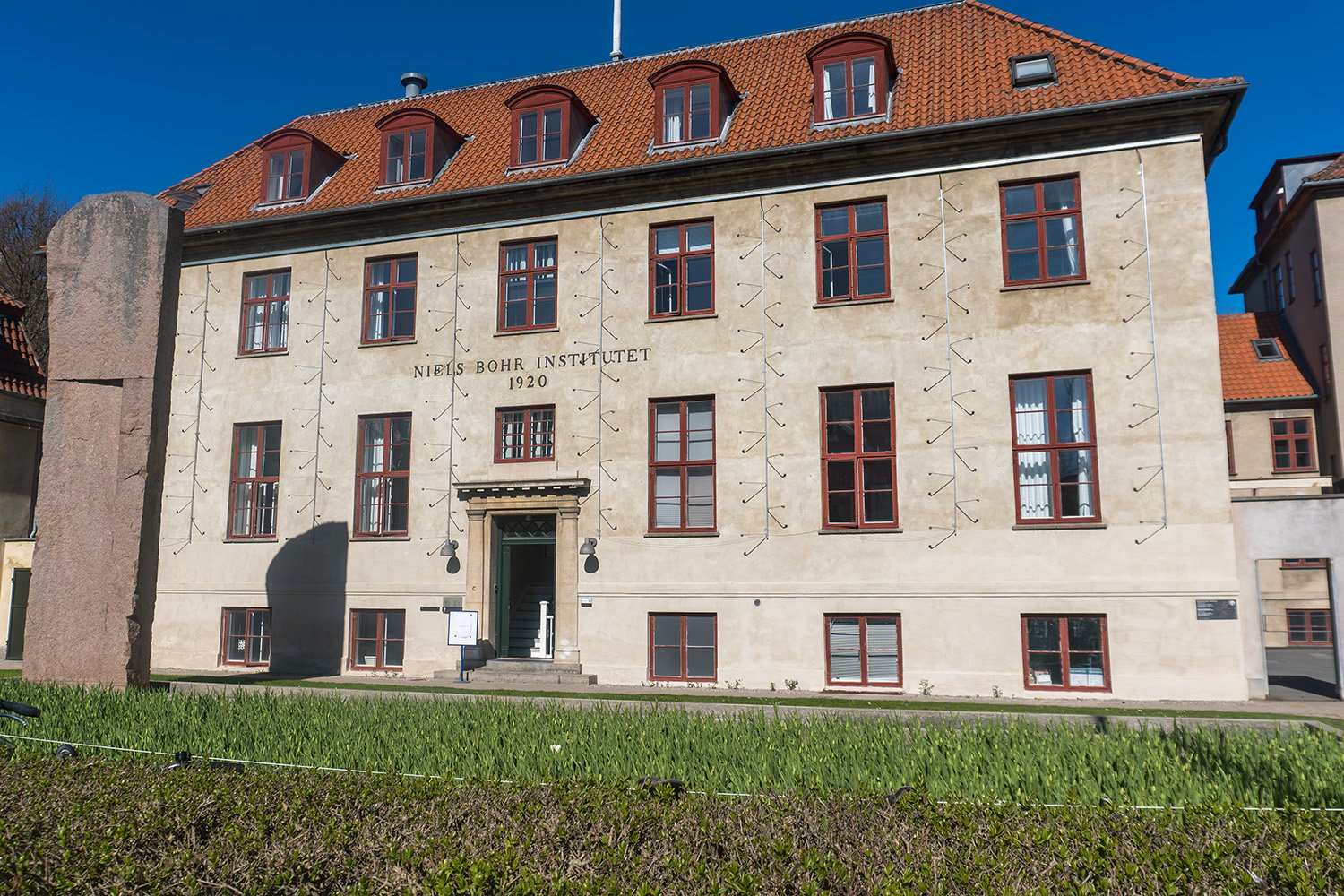
How do you create stable, flexible, and clean environments for research conducted at temperatures close to absolute zero? At the Niels Bohr Institute in Copenhagen, groundbreaking research in quantum mechanics is underway — and structures built using Rollco’s aluminium profile systems can be found in several of the laboratories.
Research demanding stable structures
The Niels Bohr Institute is part of the University of Copenhagen and an internationally recognized centre for research in quantum mechanics and the development of future quantum computers. Advanced experiments are conducted in controlled environments, and several laboratories contain structures based on Rollco’s aluminium profile systems.
Rollco has delivered numerous types of aluminium frames, mobile shelving systems, and telescopic rails for heavy-duty applications, so-called Heavy telescopic rails.
Experiments in practice – where trial and error leads to progress
Thomas Hedegaard works as a technician at the Niels Bohr Institute and is very familiar with the work carried out there. He took the time to show us around the institute and talk about their exciting projects.
At the institute, several experiments are being conducted simultaneously, exploring different materials and methods to identify optimal solutions for future quantum computers. Much of the work is carried out by university students, who are encouraged to experiment and explore solutions through trial and error to find the best approach. Thomas compares the work at the institute to chefs testing different recipes to achieve the best possible final result.


What is quantum mechanics?
Quantum physics, or quantum mechanics, is a fundamental theory in modern physics that explains how matter and energy behave at the atomic and subatomic levels. Unlike classical physics, quantum mechanics describes a world where energy exists in discrete levels and where particles can exhibit both wave-like and particle-like properties. Uncertainty and probabilities therefore play a vital role, rather than clear-cut and exact predictions.
A quantum computer uses quantum mechanical phenomena such as superposition and entanglement to process information. Instead of classical bits (0 or 1), quantum bits—qubits—are used, which can exist in multiple states simultaneously. This enables extremely fast calculations for certain types of problems, such as those in material science, chemistry, and pharmaceutical development.
−273 °C – colder than outer space
Thomas explains that quantum computers are highly dependent on extreme cold in order to operate. The tests at the Niels Bohr Institute are conducted at temperatures close to absolute zero, often just a few millikelvins. This is colder than the background temperature of outer space and corresponds to temperatures below −273 °C.
The reason is that qubits are extremely sensitive to heat. Even small amounts of thermal noise can disturb quantum states and make calculations unreliable. To reach these extreme temperatures, advanced cryogenic cooling systems, known as cryostats or “quantum refrigerators”, are used, often based on liquid helium.
Why aluminium profiles work well in cleanroom environments
Research at the Niels Bohr Institute is carried out in cleanroom environments, where it is essential to avoid unwanted particles that could contaminate the experiments.
Aluminium is a material well suited for use in cleanrooms, as it offers properties such as:
- Virtually maintenance-free and corrosion-resistant
- Low weight combined with high rigidity
- Smooth, non-porous surface that does not trap particles
- Non-magnetic
The slots in the aluminium profiles make it easy to mount accessories and adjust constructions as needed. A wide range of accessories is available to customize aluminium frames and shelving systems. This results in a flexible solution where nothing is “set in stone,” unlike, for example, welded steel frames.
At the Niels Bohr Institute, researchers and technicians design their aluminium constructions themselves. Rollco’s role is then to help turn these ideas into finished, functional solutions using components that meet cleanroom requirements as well as the demands of complex laboratory environments.
Digital accessibility and relationships that matter
Thomas explains that the Niels Bohr Institute values strong relationships with its suppliers. Good service and fast response times are important—and he considers these to be defining features of their relationship with Rollco.
He also emphasizes the importance of access to digital product information on Rollco’s website.
“If students can’t find the information they’re looking for online, there’s a substantial risk they’ll move on to another supplier. Today’s younger generation largely wants to solve things digitally on their own, without having to call or send emails.”
We would like to thank Thomas and the Niels Bohr Institute for a very rewarding visit and for the opportunity to gain insight into their exciting work in quantum research.
| Basic principles and functionality of quantum mechanics |
|
| Applications and potential |
|


