A well-chosen servo coupling acts as a precise and yet flexible link that ensures backlash-free torque transmission between motor and load, while compensating for small misalignments. It is crucial for achieving high positioning accuracy and optimal drive performance. In this article, we take a closer look at different types of servo couplings and what to consider when choosing the right type.
What makes a servo coupling special?
Unlike simpler shaft couplings, servo couplings are developed to handle high acceleration forces, fast reversing and high rotational precision without losing torsional rigidity. At the same time, they must be able to compensate for small errors in alignment – axial, angular or radial – to protect the motor and machine components against wear.
This balance between stiffness and compensation ability is central to servo technology. Too much stiffness can stress bearings and cause vibrations. Too low stiffness can lead to slippage and reduced position accuracy. The right connection creates the conditions for both precision and durability.
How to choose the right coupling for servo systems
The choice of servo coupling is influenced by many parameters, and even small details in the design can have clear effects in a servo system. Some factors that are important to consider when choosing a servo clutch are:
- Torsional rigidity and backlash-free – For precise movements and fast response. In a servo system, minimized backlash is a crucial parameter.
- Material – Stainless steel for bellows, aluminium for hubs – provides strength and low weight.
- Temperature resistance – Metal bellows couplings can withstand up to +200 °C, elastomer couplings up to +120 °C.
- Offset compensation – Axial, radial and angular offset must be handled without affecting accuracy. Choosing a coupling that matches both the engine and the machine's alignment tolerances is key to avoiding unnecessary wear.
- Assembly – EASY clamping hubs and modular designs simplify installation.
Some types of servo couplings
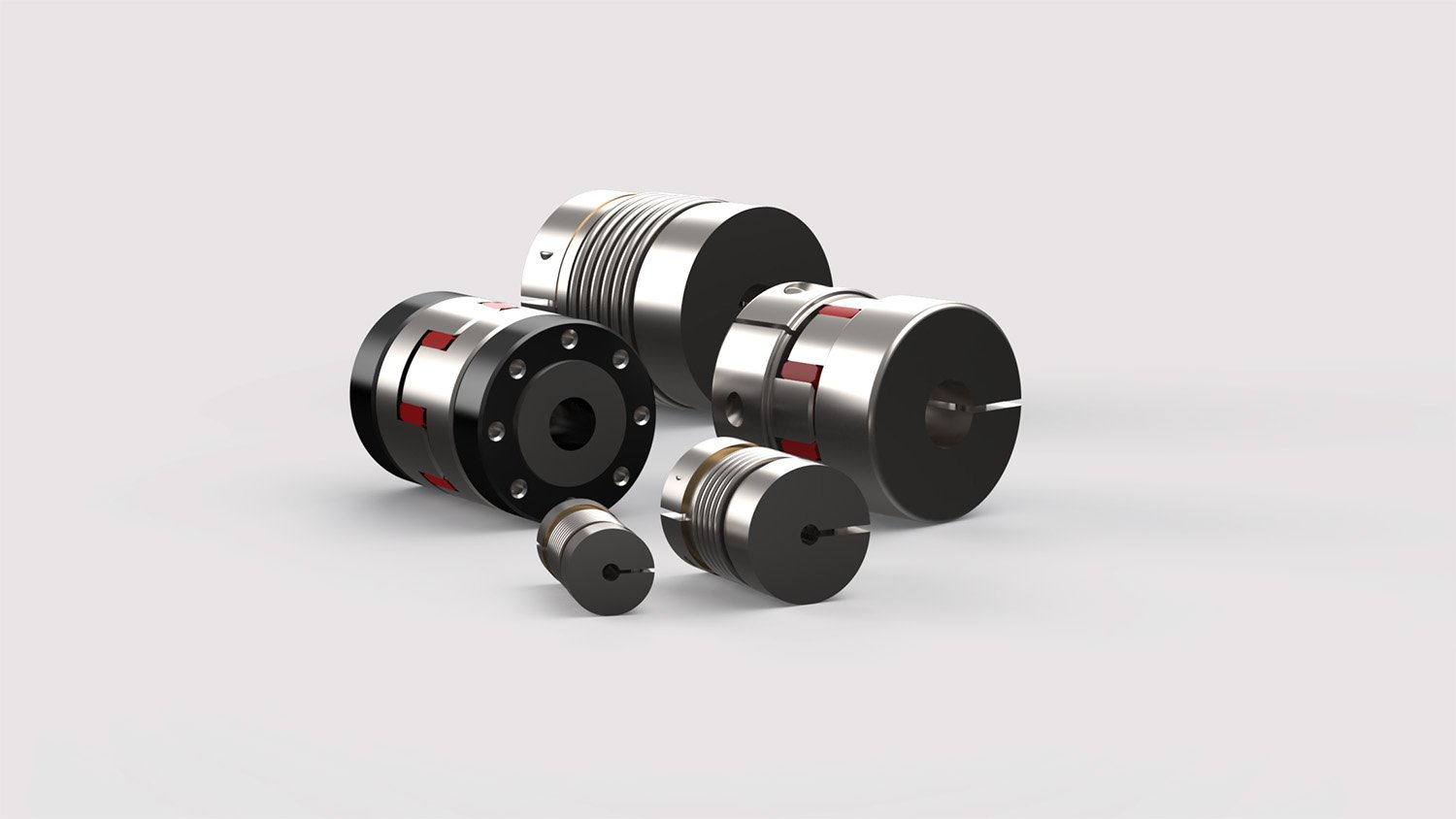
- Metal bellows couplings – Extremely torsionally rigid and with low inertia. Are ideal for high precision and direct positioning. Perfect for high-speed applications and dynamic servo drives.
- Elastomeric couplings – Flexible and vibration-damping, which can be important in machines with irregular loads. Ideal for medium torque applications. Provides electrical insulation between shafts.
- Miniature couplings
Compact solutions for stepper motors, encoders and linear units where space is limited.
Rollco's miniature couplings are of the metal bellows type that can withstand high operating temperatures and provide precise performance in applications with limited space.
Common applications - When are servo couplings the right choice?
Servo couplings are used virtually everywhere where precision and dynamics are crucial. In robotics and automation, the coupling's ability to handle high dynamics while maintaining zero backlash plays a central role in the repeatability of the systems. In CNC machines, such as milling machines, lathes and grinding machines, extreme precision is required, which is why torsionally rigid bellows or disc couplings are often used, ensuring continuous and precise power transmission even with rapid speed changes.
Even in packaging and medical technology – where short cycle times are combined with sensitive products – the need for both precision and some damping is great, making elastomer or Oldham couplings a common choice. For pumps and dosing equipment, elastomer couplings are often used to dampen pulsations and counteract vibrations, which is important for achieving stable operation and accurate dosing.
Summary
Servo couplings are critical components for ensuring high precision, stable operation and long service life in all types of servo-driven systems. By understanding differences in design, material selection and compensation capabilities, it is possible to optimize both performance and energy efficiency in a machine or plant. Whether the application is robotics, high-precision machinery, or fast automation, the correct servo coupling is a key factor in achieving the desired result.